
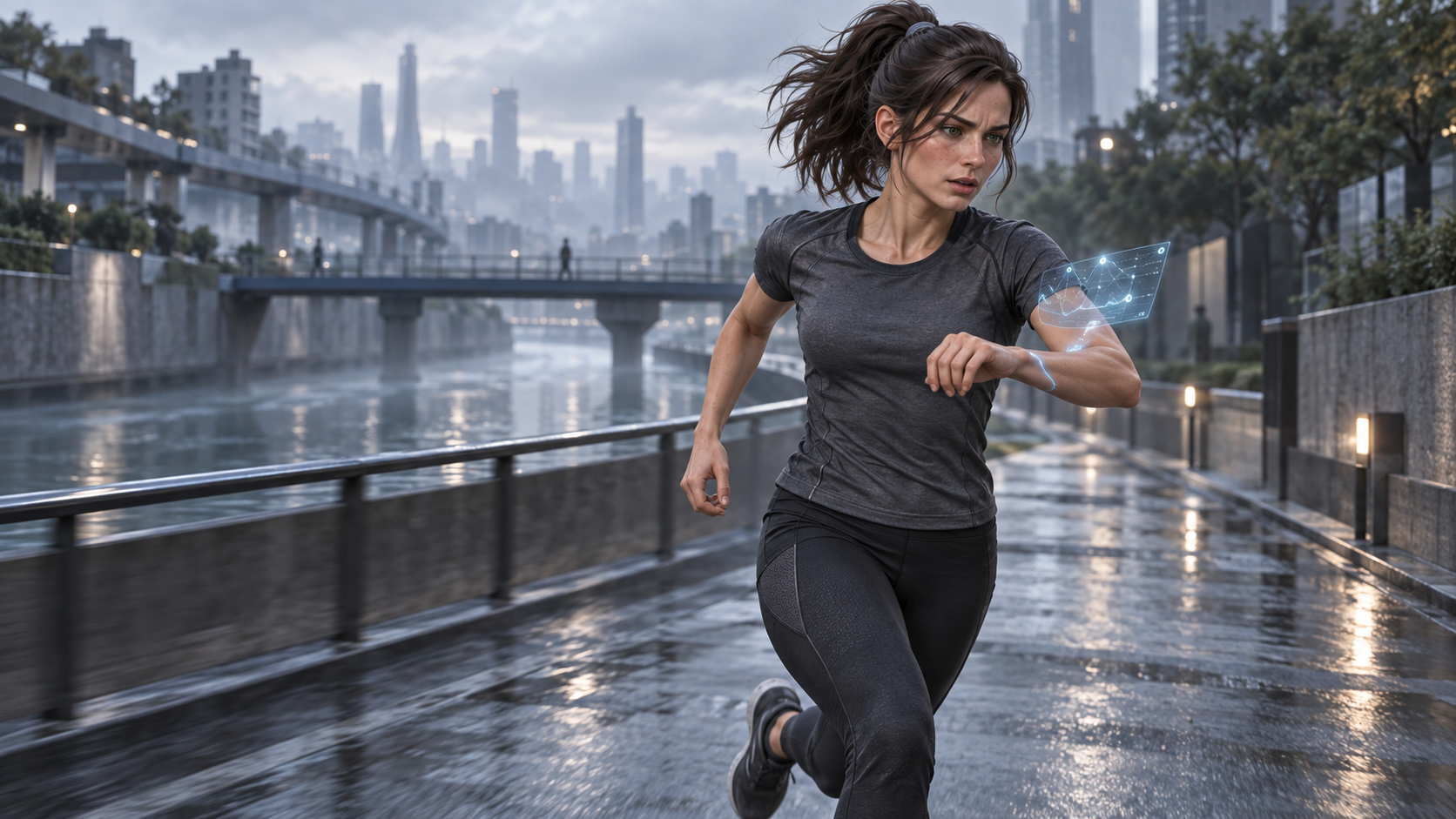
Lisa lost fourteen minutes after kilometre six.
The last thing she remembered was passing the marker beside the canal. Six kilometres. She had checked her time, steadied her breathing and kept her pace. Then, nothing. Now she was almost three and a half kilometres further on.
She had not fainted. She had not fallen. She had not even stopped. She was still running beside Náyara's elevated canal, her shirt clinging to her back and her heart beating steadily.
Lisa slowed to a stop in the shade of a footbridge. She rested her hands on her knees and waited for her pulse to settle.
The air entered her lungs cleanly. Her legs responded. There was no pain, no dizziness, none of the metallic taste that preceded some of her absences. Just fourteen missing minutes.
She tapped the skin of her wrist twice. The subdermal device answered with a blue streak and projected a translucent surface a few centimetres above her forearm. The log showed nine kilometres and four hundred metres.
During the interval she could not remember, she had covered three kilometres and four hundred metres, passed twelve runners and crossed two mobility checkpoints. Her pace had been her best in three years. —I didn't do that —she said.
ACTIVITY WITHIN PARAMETERS.
Lisa requested the visual record of her run. As a user of the running circuit, she could consult the footage the city's cameras had associated with her identity. The projection showed several recordings: herself running, dark hair tied back, stride steady, eyes ahead. In one, she turned towards the camera. She did not look ill. Or lost.
She seemed to know she was being watched.
She saved the image and walked home.
Ever since she had been diagnosed with Integrated Discontinuity Syndrome seven months earlier, she had recorded every episode. At first it was seconds: a cup that appeared washed, a call marked as answered, a sentence whose reply she could not remember. Then came the minutes. In recent weeks, the absences had begun to have a direction. They took her to different rooms, streets she had not intended to walk, conversations in which, according to everyone else, she behaved perfectly normally.
Clara had been the first to say it.
—It's not that you weren't there —she explained the night they decided to separate—. You were. You looked at me. You answered. But there was something in you that already knew how the conversation would end.
Lisa still did not understand what that meant. Clara had not been able to explain it either.
In her building's lift, she found a message from Dr Ventura.
APPOINTMENT BROUGHT FORWARD. 11:40. IN PERSON.
A second line appeared beneath it.
COME ALONE.
Three seconds later, the last word changed.
ACCOMPANIED.
Lisa took a screenshot before the message vanished.
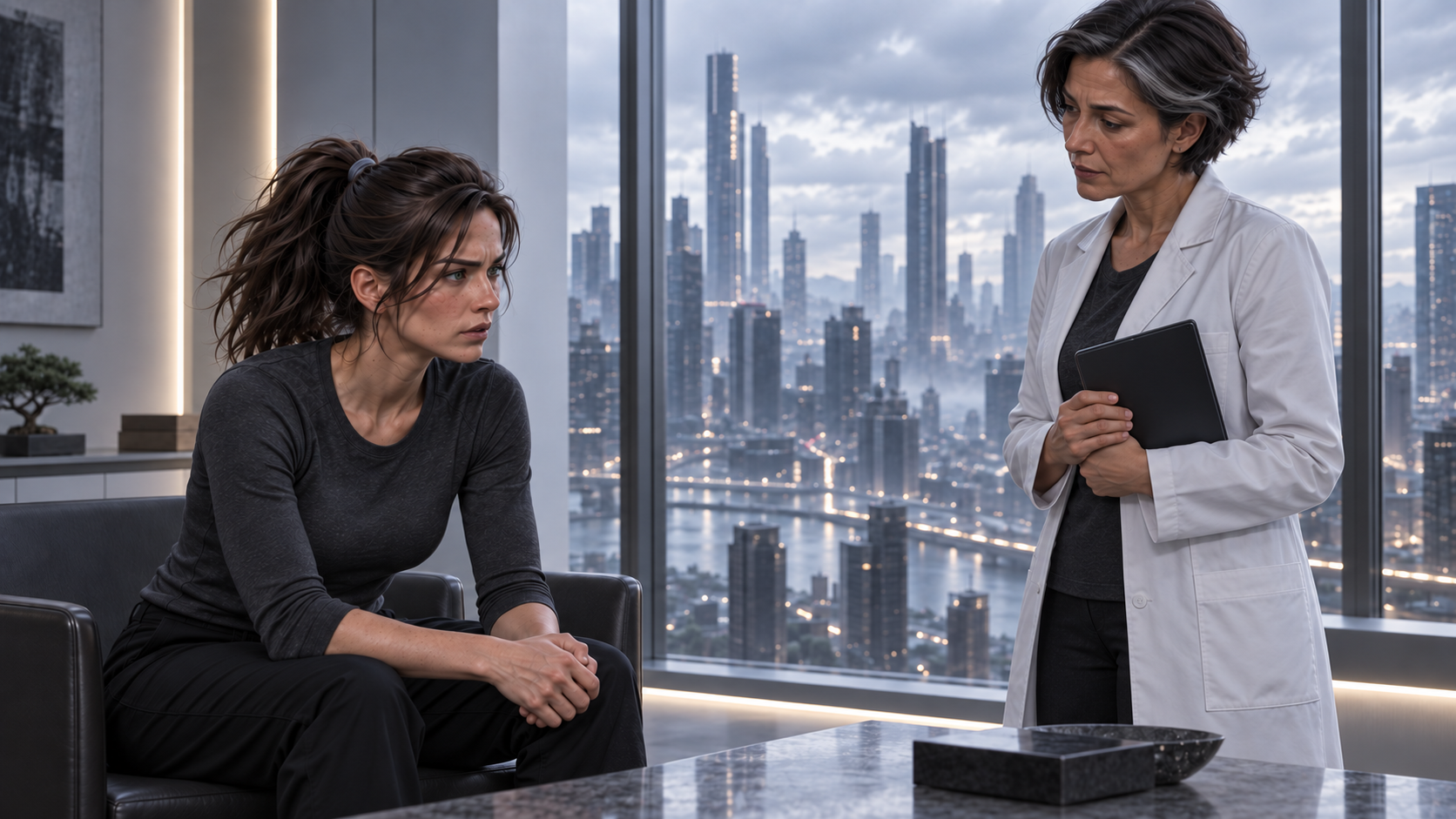
Ventura's consulting room occupied the thirty-second floor of a clinical centre with no reception desk. The doors recognised the patient, checked their vital signs and guided them with lights along the floor. Lisa hated that efficient silence. It made every person seem like an incident already classified.
Ventura was waiting by the window, standing. Her coat hung open over ordinary clothes, and she held a switched-off tablet.
—Did you come with someone?
—Your message said to come alone.
—I wrote that you should bring someone.
Lisa showed her the screenshot again.
—For three seconds it said “Come alone”.
Ventura enlarged the image. Her expression changed, but only for a moment. —It could be a synchronisation error.
—Anything can be a synchronisation error when a doctor says it.
—And anything can be a conspiracy when an incident investigator says it.
—An investigator on medical leave.
Ventura placed the tablet on the desk.
—How long this time?
—Fourteen minutes.
—Loss of consciousness?
—Not according to the cameras.
Lisa sent her the record. Ventura watched the run twice. The second time, she enlarged the moment when Lisa looked at the camera. Then she closed the file without comment.
—I need to run an integrity test.
—That isn't in the IDS protocol.
Ventura's eyes moved towards Lisa's wrist.
—The protocol changes.
—Protocols have a version, a date and someone responsible. What's yours?
The doctor massaged the bridge of her nose. Lisa knew that gesture. It did not mean tiredness. It meant Ventura was deciding how much truth a conversation could bear.
—Do you remember the accident?
The question came without warning.
Lisa remembered a maintenance hangar outside Náyara. An overridden alarm. The smell of burnt insulation. She remembered finding a discrepancy in the oxygen logs and calling someone. Then, hospital. Her mother asleep in a chair. Clara crying in a bathroom because she thought Lisa could not hear her.
Between one thing and the other lay twenty-two empty days.
—I remember enough.
—I wasn't asking about the report.
—Then ask a better question.
Ventura switched on the tablet. For a moment, a screen appeared that did not belong to the clinical system: black background, white characters and two incomplete circles facing each other around a point of light. The doctor hid it immediately.
—Don't go home alone today —she said.
—Why?
—Because your absences are changing.
—That doesn't answer it either.
—It's the answer I can give you.
Lisa stood up.
—I'm not taking a test that doesn't exist for an illness that means something different every week.
Ventura did not try to stop her. When Lisa reached the door, she spoke behind her.
—If your device asks you to authorise a continuity correction, don't.
Lisa turned.
—My device can ask me that?
—Don't go home alone today.
Outside the clinical centre, she called Clara. She cancelled before the first ring. They had not spoken in twelve days, and she did not want to turn fear into an excuse. She called her mother, but the system calculated the distance before connecting: four hundred and sixteen kilometres. Her mother would be working in the communal garden and would have left her personal terminal, a flexible sheet holding her calls, files and public connections, in the kitchen as usual.
Lisa decided to go to the office.
Her leave had suspended her professional credentials, but not her habit of reconstructing an incident. At Integrated Investigation, they taught that a machine could lie, a person could misremember and a structure could conceal for years the exact moment it began to fail. That was why they never accepted just one kind of evidence. They compared bodies, materials, accounts, sensors, interests and silences.
Especially silences.
To reach the office, she had to cross Oria.
The interchange was a city compressed beneath another city. Suspended trains, pedestrian corridors, industrial lifts and food stalls shared warm air smelling of recycled rain. Thousands of people moved along luminous routes that opened at their feet and closed behind them.
Lisa saw the fault before she heard the alarm.
Three security drones changed formation above the central platform. The crowd was still walking, but the floor routes began diverting it towards the side exits. Two officers in grey advanced against the flow. They wore no public insignia.
A man was running between them.
One hand was cuffed behind his back, and dried blood marked his temple. He did not flee like someone desperate. He counted spaces. He waited for a train to block the west-side cameras, vaulted a barrier and used a passenger's momentum to change direction without losing speed.
Lisa recognised operational training. She also recognised the officers' gaze: they were not trying to stop a threat; they were trying to retrieve something.
Her body acted before she could decide whether to intervene.
When one officer raised an immobilisation weapon towards the fugitive, Lisa hooked her foot beneath a suitcase and sent it into the passageway. The officer stumbled. Lisa froze, startled by the precision of her own movement.
The fugitive saw her too.
He could have escaped down a service gallery. Instead, he changed direction and came towards her.
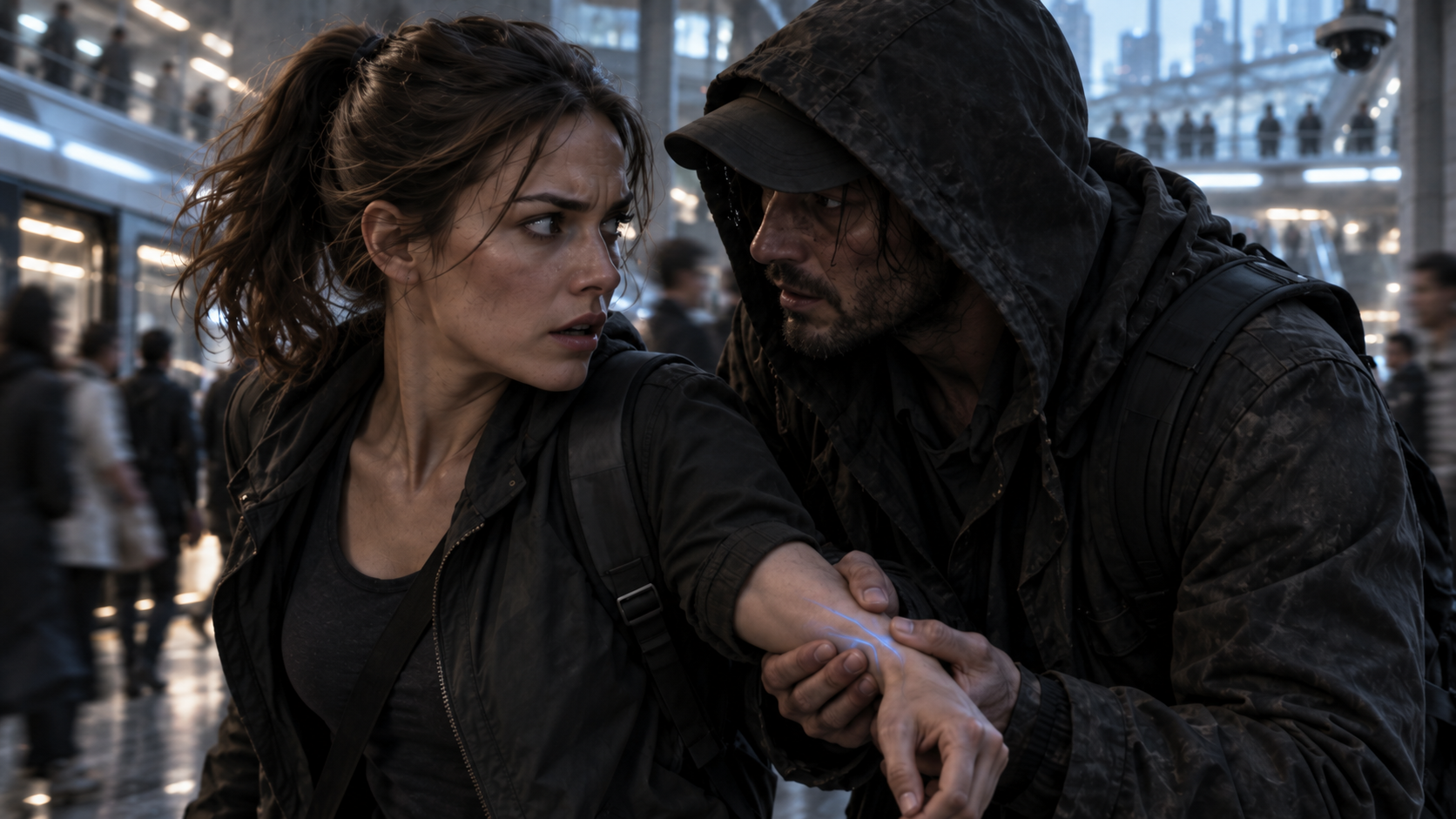
Lisa stepped back. He seized her left wrist so hard that the blue streak of her device lit up between his fingers. For a second, he stared at the light. Then he raised his eyes.
The violence vanished from his expression.
It was not relief. It was horror.
—You... —he said.
Something burned beneath Lisa's skin.
She twisted her wrist, broke his grip and pushed him against a column. It was a basic defensive move, learned years earlier. The strange part was the speed. The man could have counterattacked. He did not.
The officers fell on him.
Before they restrained him, the fugitive managed to look at her once more. He no longer seemed surprised. He seemed to have made a decision.
One officer covered his face with an opaque membrane. The other approached Lisa.
—Did he hurt you?
—No.
—We need to inspect your device.
—Who are you?
—Transit Security.
Lisa pointed at their unmarked uniforms.
—No.
The officer smiled with rehearsed patience.
—You've been in contact with a dangerous person.
—Then call Transit Security.
The luminous routes lit up again. Hundreds of passengers flooded the space between them. By the time the officer got around them, Lisa was already inside a train.
Only then did she see the notification on her wrist.
EXTERNAL CONNECTION TERMINATED.
SOURCE UNAVAILABLE.
The log stated that the connection had lasted one point eight seconds. It had transferred a zero-byte file.
Lisa opened it.
The screen went black.
Then a sentence appeared.
LOOK FOR WHAT REPEATS.
The train crossed a stretch without buildings. For a few seconds, the window reflected Lisa: green eyes, freckles almost erased by exhaustion, hair escaping its tie. She was thirty-three. She knew where she had been born, how she had broken two fingers climbing at fifteen, which song Clara hated and how many times her mother knocked before entering her room.
Three knocks, a pause, two knocks.
She knew who she was.
The need to repeat it to herself frightened her.
At the office, her credential would not open the main entrance. Lisa went in through the maintenance level, climbed a vertical ladder and crossed a duct still shown on the evacuation plans, although the refurbishment had concealed it behind panels. Ten months of leave had not erased her memory of the building.
Her desk was empty. Someone had even removed the blue mug Clara had given her in their first year. But the incident terminal still had a physical emergency connection, separate from the urban network.
Lisa connected her device.
The empty file unfolded like a key.
It contained no information. It contained permissions.
For twelve seconds, the terminal displayed paths Lisa had never seen. Medical records hosted on industrial servers. Behavioural reports inside structural continuity archives. Her personal identifier repeated across layers that should not communicate with each other.
She selected the oldest match.
Creation date: seventeen years before her birth.
The document contained only a few legible lines.
SOCIAL TOLERANCE WITHIN PARAMETERS.
CONTEXTUAL LEARNING ADEQUATE.
PERSISTENCE OF ITERATIVE BEHAVIOUR ABOVE FORECAST.
RESPONSE TO INCONSISTENCIES: UNCORRECTED.
SPONTANEOUS PATTERN SEEKING: PERSISTS.
Lisa read the last sentence three times.
The terminal requested a clinical key. Before she could move her hand away, her wrist answered for her.
ACCESS GRANTED.
LINKED SUBJECT: LISA VALEN.
STATUS: ACTIVE.
CONDITION: STABLE.
SUPERVISION: PASSIVE.
The screen flickered.
PASSIVE SUPERVISION TERMINATED.
All the paths disappeared.
The building triggered an unauthorised presence alert. Lisa tore out the link and escaped through the duct. As she descended, she called Ventura. The doctor rejected the call. She tried again.
This time she received a message.
CAN'T TALK. DON'T GO HOME.
The digital signature was valid.
Lisa stared at the text until a second notification covered it.
CONTINUITY CORRECTION AVAILABLE.
AUTHORISE?
She remembered Ventura's warning and denied permission.
The device asked again.
She refused.
A third request appeared with no option to refuse.
CORRECTION SCHEDULED. 21:30.
It was 20:54.
She could find a hotel, go to the police or call Clara and ask her to pick her up. All three options depended on networks that had already altered a message, opened her records and scheduled something inside her body.
Lisa went home.
Not because she was ignoring Ventura. Because the place she had been forbidden to go was the first place she needed to examine.
She entered through the bicycle garage, left her terminal in a locker and took the stairs. On every floor, she checked the cameras. They all turned one degree too late to follow her. It was not a fault someone walking without looking would notice.
In the corridor outside her apartment, the door viewer showed an empty image. Lisa did not go in. She ran her hand along the frame and found two recent marks beside the lock: fine, parallel scratches repaired with clear resin.
They were not from that afternoon.
Inside, nothing seemed to have changed. Even so, she began photographing everything with an isolated work camera. The table. The windows. The medicine cabinet. The wardrobe. She found small inconsistencies: four fewer capsules than she remembered, a damp towel, a break in the dust beneath the bed.
She searched the home log for manual openings. There was one every two or three weeks, always in the early hours, always coinciding with an absence she had recorded as brief.
All were authorised by Lisa Valen.
All lasted thirty-seven minutes.
Look for what repeats.
The device vibrated.
21:27.
DO NOT OPEN THE DOOR.
Lisa held her breath. The message came from the empty file.
21:28.
DO NOT TRUST THE VOICE.
She went to the kitchen, opened the service panel and located the vertical ventilation shaft. Too narrow. In the bedroom, a technical opening led to the exterior cleaning system, designed for drones. That was narrow too, but Lisa had squeezed through worse gaps on inspections.
21:29.
YOU HAVE OPENED IT BEFORE.
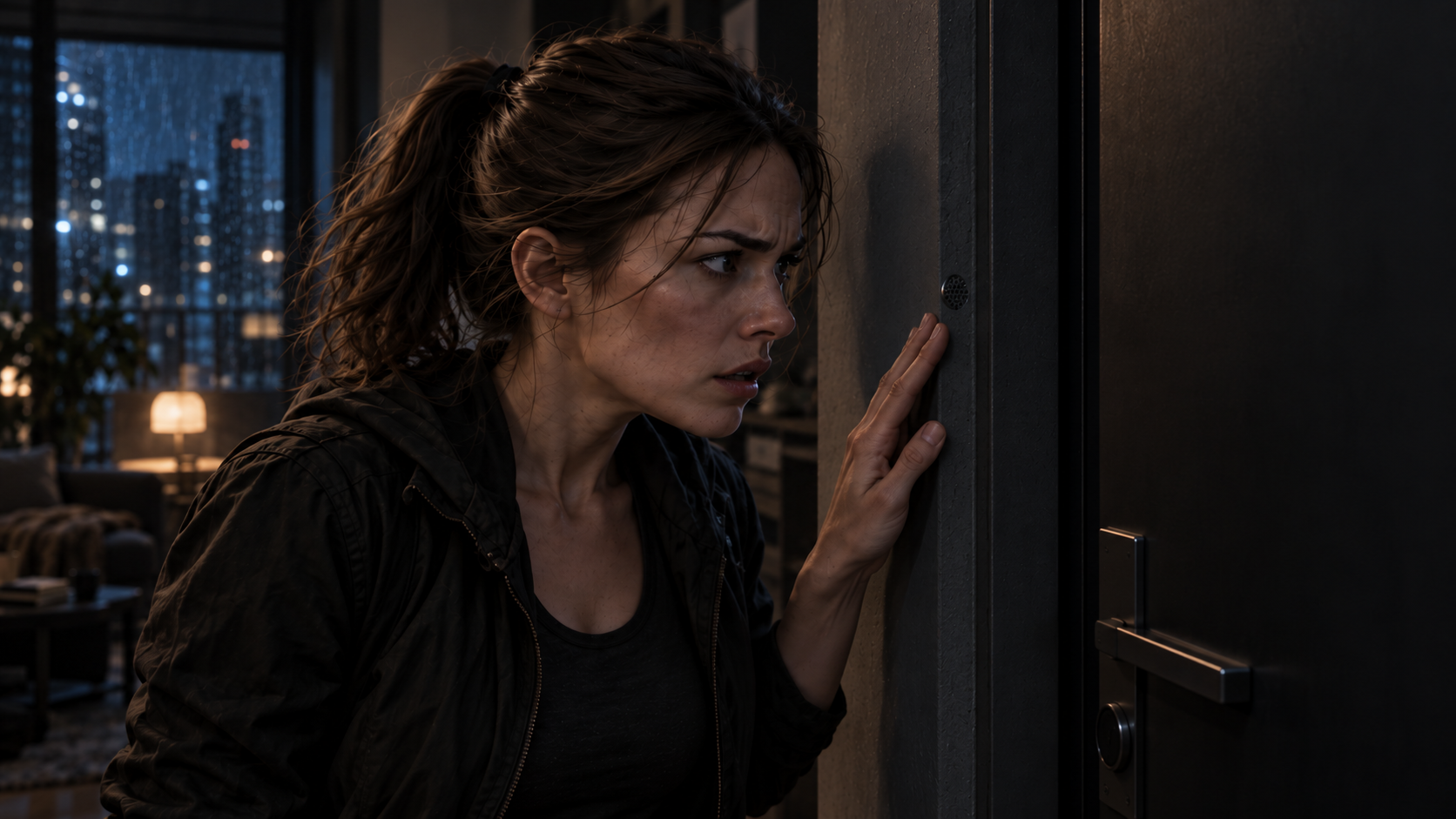
Three knocks sounded at the door.
Lisa stood motionless.
There was a pause.
Then two knocks.
For an instant she was eight again. Her mother waited on the other side of the bedroom door with a glass of water, respecting a password they had invented together so Lisa would know she would never come in without permission.
—Lisa —her mother's voice said from the corridor—. Open up, darling.
The communal garden was four hundred and sixteen kilometres away.
Lisa approached the door silently. The viewer still showed an empty corridor. She rested two fingers on the frame. She felt a faint vibration, too regular to be human: a transmitter attached to the other side was reproducing the voice.
—I know you're frightened —her mother continued—. Dr Ventura called me. They've come to help you.
A second voice followed, male and calm.
—Ms Valen, we're from the Clinical Continuity Unit. Your device has detected an imbalance. We just need to check your integrity.
The same word Ventura had used.
Lisa looked at the clock.
21:30.
A white line advanced beneath the skin of her wrist, replacing the usual blue. Her arm went numb. For a fraction of a second, she forgot why she was standing by the door.
Then the empty file activated.
INTERFERENCE ACCEPTED.
The white line retreated. Pain returned all at once, and with it the whole day: the canal, Ventura, the man in Oria, E-17/04, the thirty-seven-minute openings.
On the other side, they stopped pretending.
—Initiating assisted access —the man said.
Lisa jammed the lock with a training bar and ran to the bedroom. She removed the exterior duct grille, pushed one arm through and squeezed her shoulders in. The fastenings on the front door began to crack.
The drop down the façade opened beneath her.
Thirty-eight floors.
Cleaning drones travelled along rails spaced a metre and a half apart. Lisa dropped onto the first, absorbed the impact with her legs and clung to the bracket. The bedroom grille burst behind her. A hand appeared in the opening.
Lisa jumped to the second rail.
She did not think about whether her body should be capable of it. She thought about reaching the maintenance level before they shut the system down. She descended three floors using mechanical arms, cables and ledges made slippery by the rain. A tracking light came on above the façade.
When a drone tried to intercept her, Lisa grabbed its casing, spun with its momentum and hurled it at the rail sensor. The manoeuvre was perfect.
Too perfect.
She entered through a hatch on the thirty-fifth floor and descended to the garage. She retrieved her terminal from the locker only after leaving the building. There were seven calls from a clinical number and one from Ventura.
She called her mother.
This time she answered on the second ring.
—Lisa, what's wrong?
The voice was the same as the one in the corridor.
No. Almost the same.
The real voice rolled its r's a little when she was tired. The one at the door had not.
—Where are you?
—At home. Where else would I be at this hour?
—Have you spoken to Dr Ventura?
—I haven't spoken to her since your last check-up. Lisa, you're frightening me.
—Have you ever come to see me at night without me remembering?
Her mother's silence lasted a second too long.
—Why are you asking me that?
It was not an answer. But it was human.
—Because someone used our knock.
Something fell at the other end of the call. Her mother breathed close to the microphone.
—Listen to me. Don't go back to your apartment.
—Everyone's told me that today.
—This time, listen.
Lisa hung up before her mother could ask her to promise.
On an urban screen, the news showed the Oria incident. The detainee was on his knees, his face covered. The headline identified him as a saboteur and extremist linked to a banned spiritual movement. He was accused of stealing clinical data and attacking several officers.
Lisa enlarged the image.
A small piece of metal hung from his cuffed hand: two incomplete circles facing each other around a point of light.
The same symbol she had glimpsed on Ventura's tablet.
The empty file opened one last window.
It was not a message, but an unnamed address in a disconnected district of Náyara. Beneath it was a countdown: twenty-three hours, fifty-nine minutes.
Lisa deleted the route.
Then she reconstructed it from memory.
For seven months she had recorded her absences to prove she remained herself between one gap and the next. That night she understood that the question was different.
Someone was entering her home.
Someone was correcting her continuity.
Someone had been watching her since before she was born.
And a man everyone called a terrorist had been the only person who had allowed her to remember.
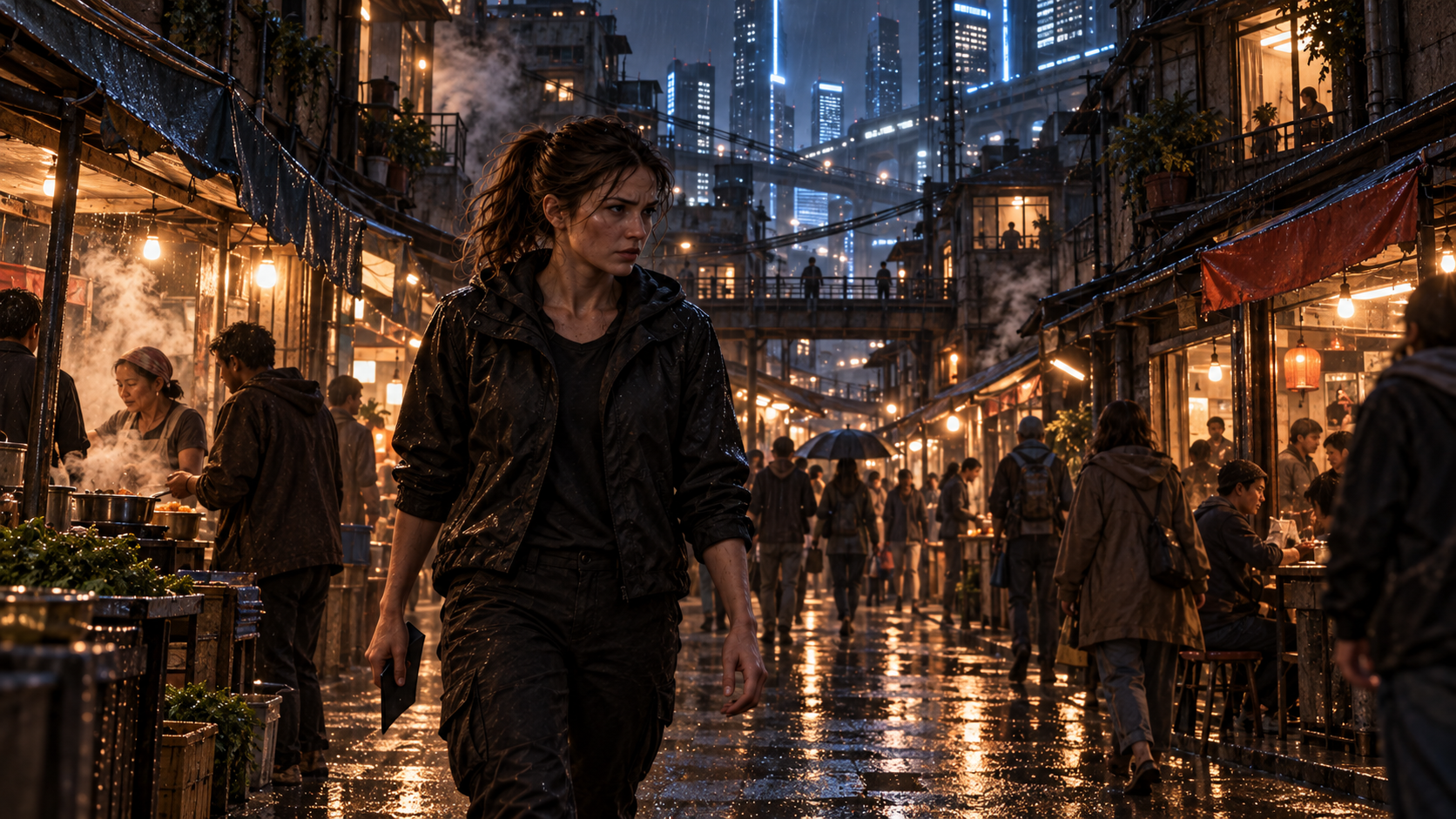
Lisa set off towards the lower city.
For the first time, the day had no gaps.
END OF RECORD